+8613662928075
 sales@hinicable.com


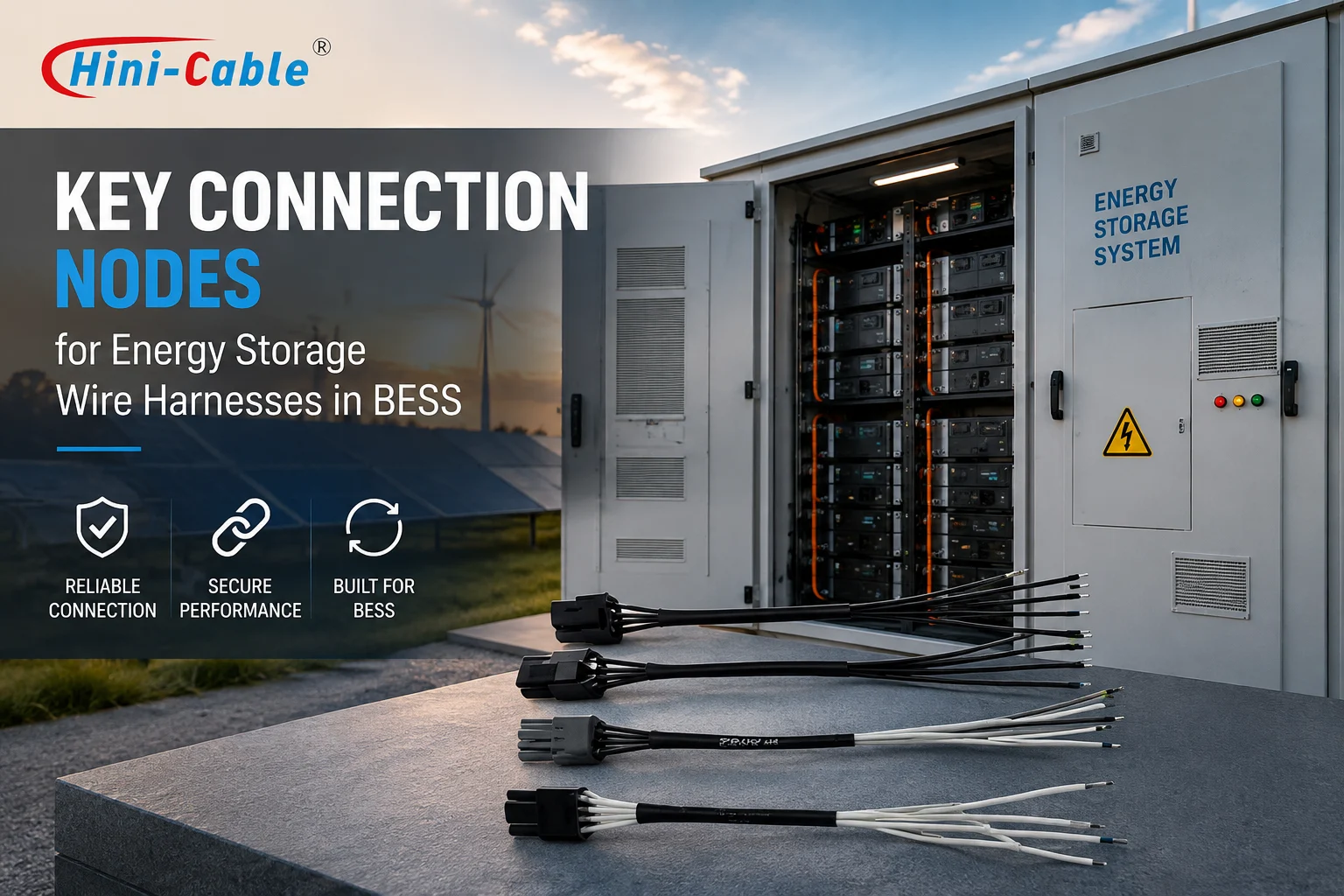
Battery Energy Storage Systems (BESS) rely on reliable electrical connectivity to maintain grid stability, operational safety, and overall system efficiency. For system integrators and procurement engineers, selecting the right internal cabling is therefore a critical engineering decision.
A common question is: Why can’t standard industrial cables be used universally across battery racks, control systems, and Power Conversion Systems (PCS)?
The answer lies in the different electrical, mechanical, and environmental requirements at each connection point.
In a utility-scale or commercial BESS, the energy storage wire harness functions as both the system’s electrical circulatory network and its communication infrastructure. High-voltage power connections may require 200A–500A+ ampacity and 1000V–1500V DC insulation, while low-voltage BMS harnesses require precise signal transmission and EMI shielding to protect CAN bus communication.
Understanding these connection nodes helps procurement teams define appropriate cable specifications, reduce electrical and thermal risks, and select a qualified energy storage wire harness manufacturer.
1. BESS Wire Harness Requirements Vary by Connection Node
A BESS contains multiple electrical connection points, but three nodes are especially important when specifying custom wire harnesses:
- Battery module-to-module interconnects
- BMS data acquisition and control connections
- Battery rack-to-PCS/inverter power connections
Each node has a different combination of voltage, current, signal, thermal, mechanical, and environmental requirements.
| Connection Node | Primary Function | Voltage & Current Class | Critical Engineering Requirement |
|---|---|---|---|
| Module-to-Module Interconnect | High-voltage series/parallel power connection | 1000V–1500V DC; 200A–500A+ | High ampacity and flame retardancy, including UL 94-V0 requirements |
| BMS Signal & Control | Low-voltage data, temperature, and CAN communication | Low voltage; 12V/24V DC | EMI shielding, twisted pairs, signal integrity, and high reliability |
| Battery Rack to PCS/Inverter | High-power output to the Power Conversion System | 1000V–1500V DC; high current | Overload resistance, environmental protection, and IP67/IP68 sealing |
This comparison demonstrates why a single standard cable specification cannot effectively cover every BESS connection node.
2. Battery Module Interconnects: High-Voltage Power Transmission
Battery module interconnects connect individual battery modules in series or parallel within a battery rack. These connections carry substantial electrical loads and therefore require high-voltage insulation, high ampacity, mechanical flexibility, and flame-retardant performance.
High Voltage and High Ampacity
For high-power BESS applications, module interconnect cables are designed around 1000V–1500V DC operating thresholds, with continuous current capacities ranging from 200A to 500A.
The conductor and insulation system must maintain reliable electrical performance under continuous high-current operation while providing sufficient voltage insulation.
Flexible Conductors for Compact Battery Racks
Battery racks often contain tightly arranged modules, busbars, terminals, and protective components. Cable assemblies therefore need enough flexibility to accommodate restricted installation spaces and repeated routing requirements.
High-strand copper conductors combined with silicone or XLPE insulation can provide the required flexibility while supporting high-current transmission.
Flame Retardancy
Safety is another important consideration for high-voltage battery cabling. Flame-retardant materials and construction should be selected according to the requirements of the target BESS application.
For the specified design, UL 94-V0 flame-retardant performance is a key requirement for the insulation system.
3. BMS Data Acquisition and Control: Protecting Signal Integrity
The Battery Management System (BMS) continuously monitors critical battery parameters, including individual cell voltages, module temperatures, and relay states.
Unlike high-current power cables, BMS harnesses primarily focus on signal integrity, electromagnetic compatibility, and stable low-voltage power distribution.
EMI Shielding for CAN Bus Communication
High-power switching components inside the PCS can generate significant electromagnetic interference (EMI). Without appropriate shielding, this interference can affect sensitive communication circuits and potentially result in CAN bus packet loss or data corruption.
A customized BMS harness can therefore incorporate:
- Braided copper shielding
- Aluminum foil shielding
- Twisted-pair signal conductors
- Controlled cable routing
- Reliable terminal connections
These features help reduce electromagnetic interference and maintain stable communication between battery modules, sensors, control boards, and the BMS.
Stable Low-Voltage Power Distribution
BMS systems also require reliable low-voltage power and signal connections.
A precision low-voltage wiring harness can provide stable 12V/24V DC power distribution while maintaining reliable sensor and control signal transmission.
Compared with high-current battery cables, low-voltage harnesses require greater attention to signal quality, connector reliability, shielding, and wiring organization.
4. Battery Rack to PCS/Inverter: Main Power Output Connection
The connection between the main battery rack collector box and the inverter or Power Conversion System (PCS) represents one of the most important high-power pathways in a BESS.
This connection must handle high electrical loads while remaining reliable under thermal, mechanical, and environmental stress.
Thermal Integrity and Overload Resistance
Main power cables can experience significant heat generation during continuous high-current operation. The cable assembly must therefore maintain insulation integrity under elevated operating temperatures.
For the specified BESS design, the harness must withstand ambient operating temperatures of 125°C+ as well as short-duration current surges without insulation degradation.
Proper conductor sizing, insulation selection, terminal design, and crimping quality all contribute to reliable high-current performance.
IP67/IP68 Environmental Protection
Outdoor and containerized BESS installations can expose cable assemblies to moisture, dust, temperature fluctuations, and ozone.
Ruggedized cable assemblies may therefore require:
- Heavy-duty cable glands
- Touch-proof quick-lock connectors
- Sealed connector interfaces
- IP67/IP68 ingress protection
These features help protect the electrical connection from environmental contamination and support long-term field reliability.
5. Why Custom Energy Storage Wire Harnesses Are Required
The three connection nodes demonstrate a fundamental BESS engineering principle: cable performance must match the function of the connection point.
A high-voltage battery interconnect prioritizes ampacity, insulation, flexibility, and flame retardancy. A BMS harness prioritizes EMI shielding, signal integrity, and low-voltage reliability. A rack-to-PCS harness requires high-current capacity, thermal resistance, overload resilience, and environmental sealing.
Therefore, simply selecting a general-purpose industrial cable may result in unnecessary overspecification in some areas and insufficient protection in others.
A custom energy storage wire harness allows system integrators to optimize:
- Voltage rating
- Current capacity
- Conductor construction
- Insulation material
- EMI shielding
- Connector configuration
- Thermal performance
- Ingress protection
- Installation flexibility
- Terminal crimping quality
6. HINI-Cable Custom Energy Storage Wire Harness Manufacturing
HINI-Cable provides engineered cable harness solutions for automotive, industrial equipment, and renewable energy storage applications.
Its custom manufacturing capabilities cover both high-voltage power assemblies and low-voltage control harnesses.
High-Precision Low Voltage Wiring Harness
HINI-Cable’s specialized low-voltage wiring harness solutions are designed for stable and efficient power distribution across automotive, electronic, and industrial applications.
Using high-quality copper conductors and precision insulation materials, these harnesses support reliable conductivity across vehicles, control systems, and industrial equipment.
For BESS applications, low-voltage harness configurations can be adapted for BMS communication, sensor connections, control boards, and auxiliary power distribution.
Custom BESS Energy Storage Assemblies
HINI-Cable can manufacture customized energy storage assemblies, including:
- Ultra-flexible high-voltage battery cables
- Flame-retardant corrugated conduit assemblies
- High-current cable assemblies
- Custom-molded high-current connectors
- Low-voltage BMS wiring harnesses
These configurations can be developed according to the electrical and mechanical requirements of the customer’s battery architecture.
Automated Crimping and Electrical Testing
High-current cable assemblies depend heavily on terminal and crimping quality.
HINI-Cable uses automated manufacturing and inspection processes that include:
- Automated wire stripping
- Ultrasonic welding
- Terminal crimping
- Crimping force monitoring
- 100% automated continuity testing
- 100% hipot testing
These processes help identify electrical and connection defects before bulk assemblies are deployed in the field.
7. BESS Wire Harness Procurement Checklist
For system integrators and procurement engineers, specifying a BESS harness should begin with the connection node rather than simply selecting a generic cable.
Step 1: Map Cable Specifications to Each Connection Node
Define the requirements for each harness according to its actual function.
For example:
- High-voltage module interconnects → voltage rating, ampacity, insulation, flexibility, flame retardancy
- BMS harnesses → EMI shielding, twisted pairs, signal integrity, 12V/24V distribution
- Rack-to-PCS connections → current capacity, thermal performance, overload resistance, IP67/IP68 protection
This approach helps prevent both over-specifying signal cables and under-specifying high-voltage power connections.
Step 2: Verify Applicable Certifications
Before approving a harness supplier, request relevant compliance documentation for the target application.
The supplied requirements include:
- UL 1429
- UL 3239
- UL 1061
- CE
- RoHS
Procurement teams should verify that the certifications and test documentation correspond to the actual cable construction and intended application.
Step 3: Audit High-Current Terminal Crimping
Terminal connections can become critical failure points in high-current BESS assemblies.
Before authorizing mass production, request:
- Pull-force test reports
- Crimp cross-section analysis
- Crimping force records
- Temperature-rise test reports
- Continuity and hipot test results
These quality controls provide additional evidence that the harness can maintain reliable electrical connections under high-current operating conditions.
8. How to Select an Energy Storage Wire Harness Manufacturer
A qualified energy storage wire harness manufacturer should provide more than cable cutting and terminal assembly.
For BESS projects, procurement teams should evaluate the supplier’s capabilities across four areas:
| Evaluation Area | What to Check |
|---|---|
| Electrical Engineering | Voltage rating, current capacity, insulation, shielding, and conductor design |
| Mechanical Design | Flexibility, connector configuration, routing, strain relief, and enclosure integration |
| Environmental Protection | Temperature resistance, flame retardancy, IP67/IP68 sealing, and material durability |
| Quality Control | Automated crimping, continuity testing, hipot testing, pull-force testing, and crimp analysis |
A supplier capable of integrating these requirements into one customized harness solution can simplify sourcing and reduce coordination between different cable and connector vendors.
Technical Summary
A BESS does not have one universal cabling requirement. Its energy storage wire harness specifications must be matched to the electrical and environmental demands of each connection node.
Battery module interconnects focus on high voltage, high ampacity, flexibility, and flame retardancy. BMS signal and control harnesses prioritize EMI shielding, twisted-pair construction, and reliable low-voltage communication. Battery rack-to-PCS/inverter connections require high-current capacity, thermal integrity, overload resistance, and IP67/IP68 environmental protection.
By defining these requirements at the connection-node level, system integrators can improve specification accuracy and reduce potential electrical and reliability risks.
HINI-Cable provides custom energy storage wire harnesses, low-voltage wiring harnesses, and high-reliability industrial cable assemblies for energy storage integrators and equipment manufacturers. Its capabilities cover customized cable construction, connector integration, automated crimping, electrical testing, and BESS-oriented harness manufacturing.