+8613662928075
 sales@hinicable.com

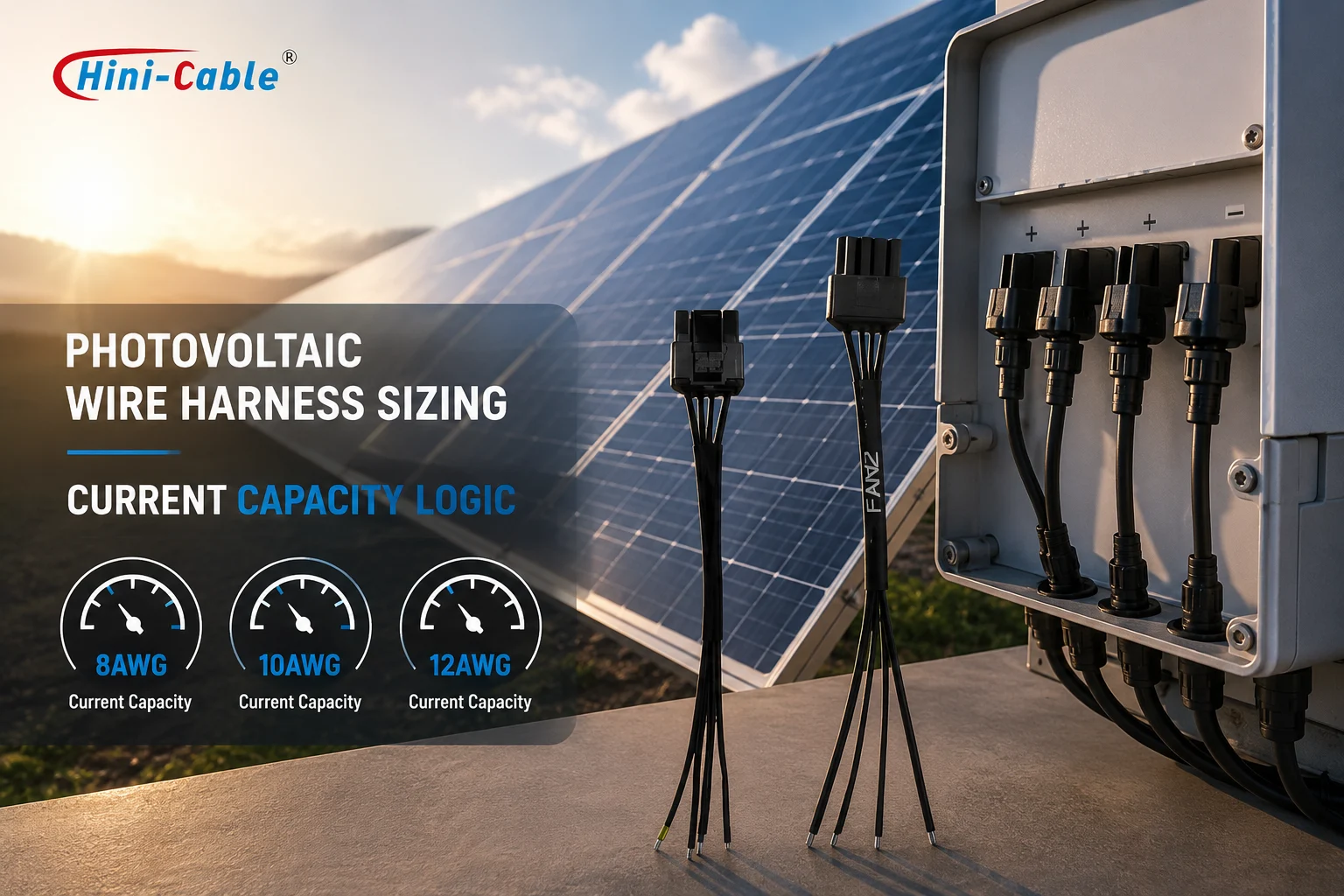
Selecting the correct cable gauge for a photovoltaic wire harness is one of the most important decisions in solar system design. Procurement teams and project engineers must evaluate different American Wire Gauge (AWG) sizes, including 12AWG, 10AWG, 8AWG, and 6AWG, based on current, cable length, voltage drop, temperature, and installation conditions.
The basic AWG rule is straightforward: the smaller the AWG number, the thicker the conductor. A thicker conductor generally has lower electrical resistance and higher current-carrying capacity.
For individual solar module connections, 12AWG and 10AWG are commonly used. However, when multiple PV strings are combined into a central trunk line, the total current increases. These higher-current connections may require 8AWG or 6AWG conductors to control heat buildup, reduce electrical losses, and maintain acceptable voltage drop.
1. Understanding AWG Sizing for Photovoltaic Wire Harnesses
AWG selection should not be based on conductor size alone. Engineers need to balance ampacity, resistance, voltage drop, cable length, and application requirements.
As the conductor becomes thicker, resistance decreases. This allows the cable to carry higher current with less heat generation and lower voltage loss.
The following comparison provides a practical starting point for selecting a photovoltaic wire harness:
| Wire Gauge (AWG) | Conductor Cross-Section | Base Ampacity (90°C PV Wire) | Resistance (Ω/1000 ft) | Primary Solar Application |
|---|---|---|---|---|
| 12 AWG | ~3.3 mm² (2.05 mm dia.) | ~25A–30A | ~1.62 Ω | Short module jumper leads and small residential branch circuits |
| 10 AWG | ~6.0 mm² (2.59 mm dia.) | ~35A–40A | ~1.02 Ω | Industry Standard: Panel-to-panel string wiring and roof-to-inverter homeruns |
| 8 AWG | ~10.0 mm² (3.26 mm dia.) | ~50A–55A | ~0.64 Ω | Multi-string parallel trunk lines, combiner box outputs, and long home runs |
| 6 AWG | ~16.0 mm² (4.11 mm dia.) | ~65A–75A | ~0.40 Ω | Commercial combiner trunks and high-current hybrid inverter connections |
These values provide a general comparison. Actual cable sizing should also account for installation conditions, conductor temperature, continuous load requirements, cable length, and applicable electrical codes.
2. 12AWG vs. 10AWG: Choosing the Right PV String Cable
For individual modules and PV strings, 12AWG and 10AWG are common choices. The correct option depends primarily on operating current, cable length, and system requirements.
12AWG Photovoltaic Wire Harness for Short Connections
12AWG is well suited to low-wattage residential arrays and short module lead whips where the individual panel operating current ($I_{mp}$) remains well below 15A.
Its smaller conductor size can be appropriate when cable runs are short and current requirements remain relatively low.
Typical applications include:
- Short solar module jumper leads
- Low-wattage residential PV arrays
- Short branch-circuit connections
- Individual module connections with relatively low operating current
10AWG Solar Cable for Standard PV Strings
10AWG provides a widely used balance between current capacity, voltage drop, mechanical durability, and cost.
It is commonly applied to:
- Panel-to-panel string wiring
- Roof-to-inverter homeruns
- Modern commercial PV module strings
- Solar installations with higher module operating currents
For many standard PV installations, 10AWG provides sufficient current-carrying capacity while maintaining a practical cable size for installation and routing.
3. 8AWG vs. 6AWG for High-Current PV Trunk Harnesses
The requirements change when several solar strings are connected in parallel.
How Parallel String Connections Increase Current
When two or three 10AWG PV strings are combined through Y-branch connectors or a custom trunk harness, their currents are added together:
Itotal=I1+I2+I3I_{total}=I_1+I_2+I_3
For example, if three strings each produce operating current, the trunk conductor must be sized for the combined current rather than the current of a single module string.
This is why a photovoltaic wire harness used as a central trunk line may require a larger conductor than the individual PV string cables.
When to Upgrade from 10AWG to 8AWG or 6AWG
Using a thicker conductor for the central trunk line can reduce resistance, thermal stress, and voltage drop.
8AWG is commonly considered for:
- Multi-string parallel trunk lines
- Combiner box outputs
- Longer PV homeruns
- Medium-to-high current solar DC connections
6AWG is more suitable for higher-current applications such as:
- Commercial combiner trunks
- High-current PV distribution
- Hybrid inverter connections
- Long-distance, high-load cable runs
The final gauge should be selected according to the actual system current, cable length, ambient temperature, installation method, and applicable electrical requirements.
4. Voltage Drop: Why Cable Length Matters
Cable gauge selection is also closely related to voltage drop.
As cable length increases, electrical resistance accumulates. Higher resistance produces greater voltage loss, which can reduce the usable electrical output of a solar system.
A thicker conductor has lower resistance, so upgrading from 10AWG to 8AWG or 6AWG can help control voltage drop on longer runs.
For example, a 10AWG cable may safely carry the required current but still produce excessive voltage drop over a long distance. In such cases, a larger conductor can provide a better electrical design margin.
For many solar system designs, engineers target a voltage drop of approximately 2%–3%, depending on the circuit and project requirements.
Therefore, AWG selection should consider both:
- Ampacity: Can the conductor safely carry the required current?
- Voltage drop: Can the cable maintain acceptable voltage over the required distance?
5. NEC Guidelines and Temperature Derating for PV Cable Sizing
Static ampacity tables are only the starting point when selecting a photovoltaic wire harness. Solar installations can experience high temperatures and continuous electrical loads, making proper derating essential.
5.1 Apply the 125% Continuous Load Rule
Solar PV output is treated as a continuous load in the sizing approach described here. Designers should multiply the short-circuit current ($I_{sc}$) by 125% before comparing the result with the conductor’s allowable ampacity.
This provides an engineering safety margin when selecting the appropriate conductor size.
5.2 Account for Rooftop Temperature
Rooftop PV cables can experience significantly higher temperatures than the surrounding ambient air.
On sun-exposed commercial roofs, temperatures can often exceed 60°C / 140°F. Higher conductor temperatures reduce the effective current-carrying capacity of the cable.
The original sizing approach estimates that extreme temperatures can reduce conductor capacity by approximately 20%–30%.
Under these conditions, upgrading from 10AWG to 8AWG can provide additional thermal capacity and help manage heat generation.
5.3 Consider Low Voltage Wiring Harness Requirements
Not every solar-system connection is a high-voltage DC string.
Tracking motors, sensors, control units, monitoring equipment, and other balance-of-system components may require a customized low voltage wiring harness.
These harnesses should be designed for:
- Stable power distribution
- Reliable signal transmission
- Outdoor temperature exposure
- Moisture and environmental resistance
- Application-specific connector and pinout requirements
For complex PV equipment, both the high-current photovoltaic wiring and low-voltage control wiring should be considered as part of the overall harness architecture.
6. How to Select the Right Photovoltaic Wire Harness
A practical AWG selection process can be divided into several steps.
Step 1: Determine the Operating Current
Start with the module or circuit operating current and short-circuit current. For parallel strings, calculate the combined current before selecting the trunk conductor.
Step 2: Check Required Ampacity
Compare the calculated current with the allowable ampacity of the selected PV wire after applying the required continuous-load and temperature adjustments.
Step 3: Calculate Cable Length
Longer cable runs create greater resistance and voltage drop. If the distance increases significantly, consider moving from 10AWG to 8AWG or from 8AWG to 6AWG.
Step 4: Evaluate Installation Temperature
Roof-mounted solar harnesses can operate under substantially higher temperatures than indoor electrical wiring. Temperature derating should therefore be included in the sizing calculation.
Step 5: Select Connectors and Harness Components
The conductor is only one part of a complete photovoltaic wire harness. Connectors, branch connectors, terminals, insulation, overmolding, and cable routing must also match the required current and environmental conditions.
7. Frequently Asked Questions About PV Wire Gauge Selection
Q1: Why is 10AWG commonly used for solar panel installations?
A: 10AWG offers a practical balance between current-carrying capacity, voltage drop, mechanical durability, and cost. In the sizing range discussed here, it can provide up to approximately 40A at 90°C, making it suitable for many panel-to-panel string connections and moderate-distance homeruns.
Q2: Can I connect an 8AWG trunk line to a 10AWG solar panel lead?
A: Yes. It is common to transition from thinner 10AWG module leads to a thicker 8AWG or 6AWG main trunk cable when multiple strings are combined. Specialized overmolded Y-connectors or combiner boxes can be used to manage the transition and combined current.
The connector and terminal ratings must match the actual system requirements.
Q3: How does cable length affect AWG selection?
A: Increasing cable length increases total electrical resistance and therefore increases voltage drop. A 10AWG cable may carry the required current safely but still experience excessive voltage loss over a long run.
For longer distances, such as runs exceeding 80 feet, upgrading to 8AWG may help maintain the desired voltage-drop target, depending on actual current and installation conditions.
8. Custom Photovoltaic Wire Harness Solutions from HINI-Cable
Selecting the right conductor gauge is only one part of designing a reliable solar wiring system. The complete harness must also match the project’s cable length, connector configuration, pinout, current requirements, environmental conditions, and installation method.
HINI-Cable manufactures custom photovoltaic wire harness assemblies and high-reliability low-voltage wiring harness solutions for automotive, industrial, and renewable energy equipment. 👉 PV Wire Harness
Custom solutions can be developed around requirements such as:
- Custom cable lengths
- Specific AWG sizes
- Connector and terminal selection
- Custom pinouts
- Branch and trunk harness configurations
- OEM manufacturing requirements
- Low-voltage power and signal harnesses
For solar equipment manufacturers and project procurement teams, a properly engineered harness can help balance electrical performance, installation requirements, reliability, and overall system cost.
Conclusion: 10AWG, 8AWG, or 6AWG?
There is no single AWG size that fits every solar installation.
12AWG is generally suited to short, lower-current module connections, while 10AWG is a widely used option for standard PV string wiring. When multiple strings are combined, 8AWG or 6AWG can provide the additional current capacity and lower resistance required for higher-current trunk connections.
The final photovoltaic wire harness specification should consider current, voltage drop, cable length, temperature derating, continuous-load requirements, connectors, and the overall installation environment.
By evaluating these factors together, solar system designers and procurement teams can select a harness configuration that supports reliable power transmission while controlling thermal and electrical losses.