+8613662928075
 sales@hinicable.com

Introduction: Why Static Cabling Fails in Dynamic Robotic Applications
In modern smart manufacturing and industrial automation, industrial robots execute high-speed, continuous, multi-axis motions to maintain maximum productivity. However, robotics system integrators frequently face premature equipment downtime due to a critical oversight during procurement: treating a custom wiring harness for dynamic robotic applications the same as static industrial cabling.
Unlike fixed electrical installations, a robotics wiring harness must continuously endure aggressive mechanical stresses, complex bending cycles, torsional twisting, and heavy electromagnetic interference (EMI). Specifying standard static cables in a dynamic motion environment often leads to conductor fatigue, internal wire breakage, insulation degradation, and signal loss within a fraction of the expected operational lifespan.
At HINI-Cable, as a specialized manufacturer of bespoke industrial automation wire harness solutions, we engineer high-precision assemblies designed to withstand harsh dynamic environments. This guide breaks down the three critical engineering requirements for dynamic robotic cabling—drag chain flex life, torsional resilience, and EMI shielding—and offers actionable sourcing criteria for procurement teams.
1. The Three Core Engineering Requirements for Dynamic Robotic Cabling
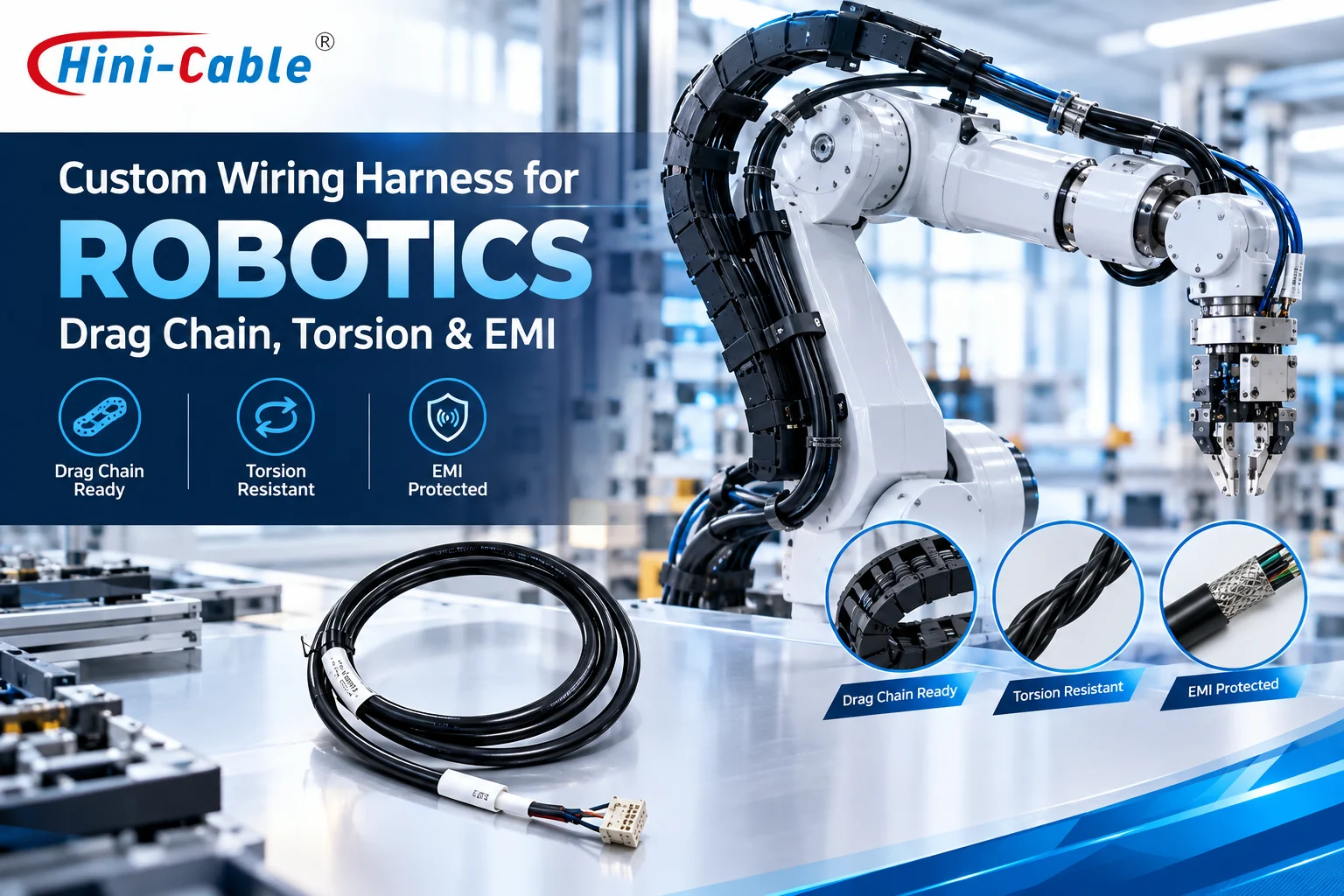
1. Drag Chain Cable Flex Life: Millions of Bending Cycles
Cables housed inside drag chains (cable carriers) undergo repetitive linear bending along a defined radius. Standard commercial cables usually fail after just tens of thousands of flex cycles due to conductor work-hardening and jacket abrasion.
-
Specialized Conductor Stranding: High-flex robotic cables utilize extra-fine, oxygen-free copper strands twisted with optimized pitch lengths to distribute bending stresses evenly.
-
Abrasion-Resistant Jacket Formulations: Outer jackets made from premium Polyurethane (PUR) or Thermoplastic Elastomer (TPE) prevent wear, tear, and oil degradation inside fast-moving drag chains.
-
Engineered Test Validation: While standard wires break quickly, dynamic custom cable assemblies are built to pass rigorous drag chain cable flex life testing—often exceeding 5 million to 10 million continuous bending cycles.
2. Torsional Performance: Multi-Axis Joint Flexibility
Six-axis articulated robots require wiring harnesses routed through articulating joints to withstand simultaneous twisting and bending (torsional stress).
-
Torsion-Optimized Internal Geometry: Unlike linear flex cables, torsional cables feature specialized low-friction core wrapping, slip-layers, and balanced helical stranding to absorb rotational force without corkscrewing.
-
3D Motion Endurance: High-quality torsional harnesses are tested to endure over $\pm 180^\circ/m$ to $\pm 360^\circ/m$ torsional angles over millions of rotational cycles.
3. EMI Shielding: Protecting Sensitive Signal Transmission
Robotic cells are packed with noise-generating components, including servo motors, variable frequency drives (VFDs), and heavy industrial welders. Sensitive feedback signals from encoders and sensors are highly vulnerable to electromagnetic interference (EMI).
-
Dual-Layer Shielding Architecture: Premium EMI shielding wiring harness designs combine tinned copper braided shielding (offering up to 85%–95% optical coverage) with aluminum foil wrapping to block both low-frequency magnetic and high-frequency electro-magnetic noise.
-
Signal Integrity: Prevents signal corruption, position feedback errors, and unprompted emergency stops in precision servo systems.
2. Technical Comparison Matrix: Static vs. Dynamic Robotics Wiring Harness
To guide system integrators during component selection, the table below compares the structural, performance, and application differences across wire harness categories.
| Engineering Attribute | Static Industrial Harness | Standard Drag Chain Harness | High-Flex Robotics Wiring Harness (HINI-Cable) |
| Primary Motion Profile | Fixed installation / No motion | Linear 2D bending (Drag Chain) | 3D Complex Motion (Bending + Torsion + Vibration) |
| Bending Resistance (Flex Life) | $< 50,000$ cycles | 1 Million – 5 Million cycles | 5 Million – 10+ Million continuous cycles |
| Torsional Resistance ($\pm 180^\circ/m$) | None (Immediate structural failure) | Limited | Exceptional (Engineered for 6-axis joint articulation) |
| Conductor Construction | Standard coarse copper stranding | Fine copper stranding | Ultra-fine, high-purity micro-stranded copper core |
| EMI Shielding Level | Single foil or unshielded | Standard single braid | Dual-layer (Braided tinned copper + Aluminum foil) |
| Outer Jacket Material | Standard PVC | PVC / PUR | Premium PUR / TPE (Oil, flame, & abrasion resistant) |
3. Procurement Guide: Specifying the Right Custom Harness for Your Robot
When sourcing a custom wiring harness for automated systems, system integrators should clearly define operational parameters before finalizing specifications:
-
Map the Exact Motion Profile: Clarify whether the application involves pure linear drag-chain bending, pure multi-axis rotational torsion, or a complex 3D hybrid motion.
-
Define Mechanical Parameters: Specify the minimum bend radius ($R$), stroke length, travel velocity, acceleration rate, and required total flex cycle lifespan.
-
Assess Environmental & EMI Exposures: Identify ambient operating temperatures, chemical/oil contact, mechanical abrasion risks, and nearby high-voltage noise sources affecting encoder lines.
-
Demand Verified Test Reports: Partner with manufacturers that provide certified test data for flex life, torsional resistance, and shield effectiveness.
4. The HINI-Cable Advantage: Engineered for Reliable Connectivity
At HINI-Cable, we specialize in delivering custom cable assembly solutions engineered for reliable electrical connectivity in complex industrial and electronic systems. Our custom wiring harness solutions deliver high-precision assembly, stable performance, and flexible design options tailored to demanding motion environments:
-
Multidisciplinary Expertise: Our custom wiring harnesses are widely used in automotive, robotics, medical devices, and industrial automation applications, ensuring efficient and durable signal and power transmission.
-
Precision Assembly & Testing: Every custom harness undergoes strict continuity, insulation, pull-force, and EMI shielding verification to guarantee zero-defect performance in the field.
-
Custom OEM/ODM Engineering: From high-flex servo motor cables to complex multi-core sensor assemblies, our engineering team works directly with your CAD models to design optimized harness configurations.
Conclusion: Protect Your Automation Systems with HINI-Cable
Failure to account for dynamic motion, torsional stress, and electromagnetic noise can lead to costly unscheduled downtime for industrial robots. By prioritizing specialized flex life, torsional design, and dual-layer EMI shielding, automation engineers can ensure long-term operational reliability.
Partner with HINI-Cable to equip your automated machinery with precision-engineered, high-flex custom wiring harness solutions. Contact our engineering support team today to review your application requirements, request product samples, or receive a customized manufacturing quote.