+8613662928075
 sales@hinicable.com


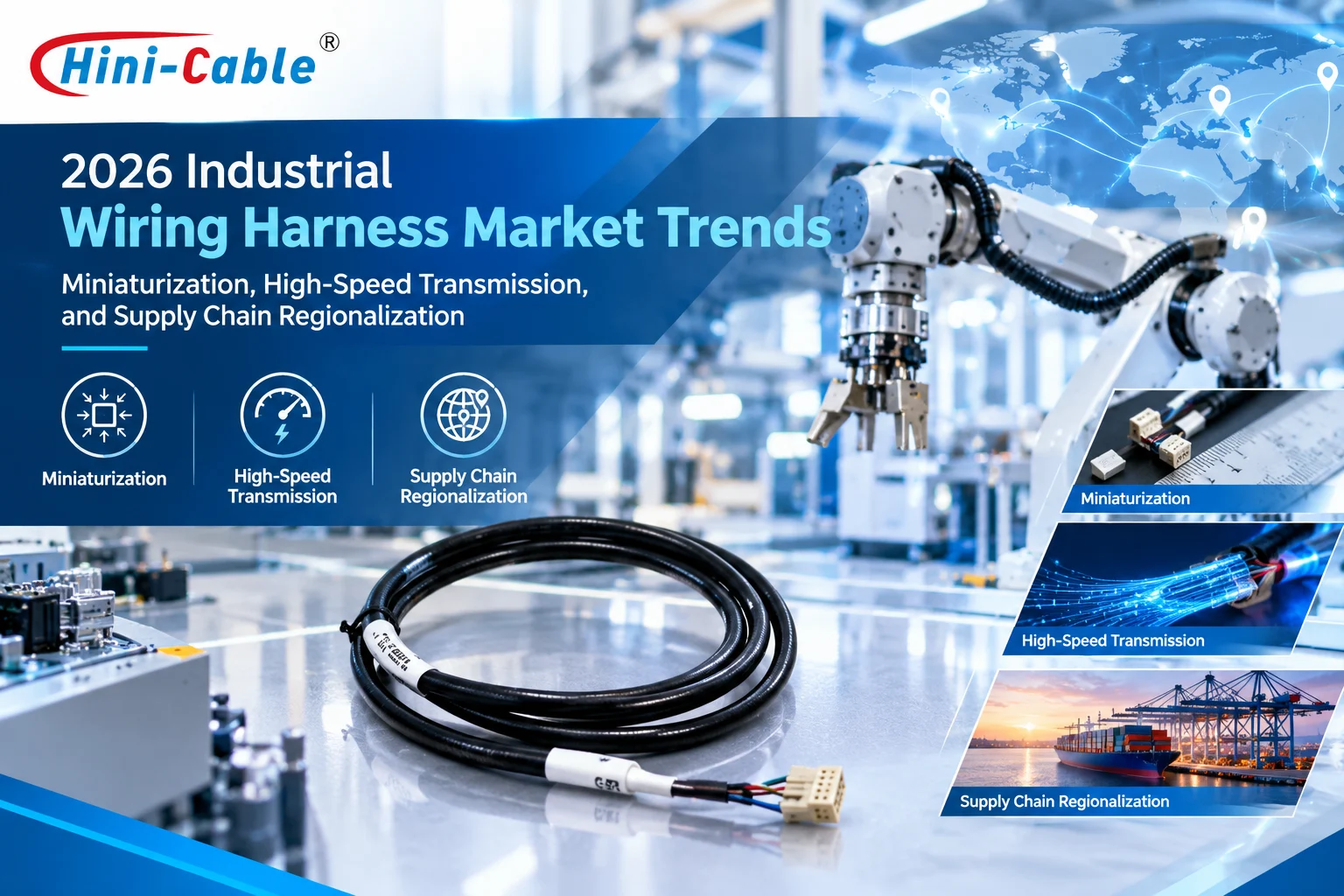
Navigating the 2026 Industrial Connectivity Landscape
As global manufacturing accelerates toward Industry 4.0, smart automation, and advanced robotics, the demand for high-reliability electrical connectivity is evolving rapidly. For procurement officers, supply chain directors, and OEM product engineers, staying ahead of market shifts is essential to making informed sourcing decisions and ensuring long-term product competitive advantage. In 2026, the industrial wire assembly market is defined by three powerful forces: structural miniaturization, high-frequency data transmission demands, and widespread supply chain regionalization.
Selecting the right custom wiring harness requires balancing cutting-edge engineering specifications against global supply chain resilience. At HINI-Cable, we engineer bespoke connectivity solutions that address these exact market shifts. This article breaks down the pivotal 2026 industrial wiring harness trends, provides a comparative technical matrix, and offers actionable sourcing strategies for international procurement teams.
1. Core Market Trends Driving Industrial Wire Harness Sourcing in 2026
Trend 1: Extreme Miniaturization (28–32 AWG & Fine-Pitch Connectors)
As industrial automation machinery, medical equipment, and compact robotic arms become smaller and more integrated, internal spatial constraints have tightened dramatically.
-
Finer Wire Gauges: Standard industrial wiring (20–24 AWG) is increasingly being replaced by micro-wire gauges ranging from 28 AWG to 32 AWG.
-
Fine-Pitch Interconnects: Compact designs require connectors with sub-millimeter pitch spacing, demanding extreme precision during automated crimping and insulation stripping.
-
Flexibility in Tight Radius Bends: Miniaturized wiring allows tight bending radii without compromising mechanical fatigue life or signal stability.
Trend 2: High-Speed Transmission & Advanced Shielding Requirements
The proliferation of Industrial Ethernet, machine vision systems, and high-resolution sensor networks (such as USB 3.0, Single Pair Ethernet, and gigabit bus systems) requires harnesses that do more than carry simple power loads—they must deliver uncorrupted high-speed data.
-
Strict Impedance Control: Signal reflection and packet loss require strict characteristic impedance matching ($100\,\Omega \pm 10\%$ for Ethernet).
-
Multi-Layer EMI/RFI Shielding: Dense industrial electromagnetic environments demand double-shielded topologies (braided tinned copper combined with aluminum foil wrapping) to prevent signal interference.
Trend 3: Supply Chain Regionalization and Nearshoring
Geopolitical volatility, trade policy shifts, and logistics bottlenecks have driven European and North American OEMs toward nearshoring and “friend-shoring” strategies.
-
Dual-Sourcing & Multi-Region Manufacturing: Procurement teams are abandoning single-region supply strategies in favor of suppliers with multi-regional production footprints.
-
Mitigating Lead Time Risks: Regional production hubs reduce ocean freight delays, lower buffer inventory holding costs, and enable faster engineering revisions.
2. Technical Comparison Matrix: 2026 Harness Specifications vs. Legacy Systems
To guide engineering and procurement evaluations, the table below compares legacy industrial wiring setups against 2026 high-performance harness standards.
| Technical Parameter | Legacy Industrial Wiring Setup | 2026 Next-Gen Custom Wiring Harness | Primary Procurement & Engineering Benefit |
| Typical Conductor Gauge | 18 AWG – 24 AWG | 28 AWG – 32 AWG (Micro-Conductors) | Up to 40% spatial savings; lighter total assembly weight |
| Data Bandwidth Support | Low-frequency signals / Basic CAN bus | High-speed Industrial Ethernet, USB 3.0, SPE | Supports real-time AI processing and machine vision data |
| Shielding Topology | Single foil wrap or basic spiral braid | Dual-layer (Al-Mylar Foil + High-Density Tinned Braid) | Superior EMI protection in high-noise factory environments |
| Flex Life & Mechanical Fatigue | Standard static flex rating | High-flex continuous motion rating (>5 million cycles) | Prevents conductor breakage in dynamic robotic joints |
| Supply Chain Footprint | Single-source centralized production | Regionalized / Multi-hub global production | Enhanced supply chain resilience and shortened lead times |
3. Procurement Action Plan: Evaluating Supplier Capabilities for 2026
To safeguard your production lines against component failures and supply chain disruptions, consider the following evaluation criteria during supplier selection:
-
Verify Precision Assembly Standards: Ensure your global wiring harness manufacturer utilizes automated crimping, micro-wire stripping machinery, and 100% automated optical inspection (AOI) for fine-pitch connectors.
-
Audit High-Speed Signal Testing Facilities: Confirm that the supplier conducts rigorous Time-Domain Reflectometry (TDR) and insertion loss testing for high-bandwidth assemblies.
-
Assess Supply Chain Resilience: Evaluate the vendor’s global manufacturing footprint, raw material buffer strategies, and dual-sourcing options to insulate your business from geopolitical trade shocks.
4. The HINI-Cable Engineering Advantage
At HINI-Cable, we specialize in transforming complex connectivity requirements into robust, high-precision products. Every custom wiring harness we build is engineered for reliable electrical connectivity in complex industrial and electronic systems.
-
Precision Engineering: Our custom wiring harness delivers high-precision assembly, stable performance, and flexible design options tailored to demanding spatial and electrical constraints.
-
Versatile Industry Applications: The custom wiring harness from HINI-Cable is widely used in automotive systems, advanced robotics, medical devices, and industrial automation applications.
-
Uncompromising Quality Control: We guarantee efficient and durable signal and power transmission through rigorous testing, including pull-force testing, continuity checks, and high-voltage insulation breakdown testing.
-
Global Sourcing & Flexibility: Designed to meet the stringent requirements of international OEMs, our engineering team supports full design-for-manufacturability (DFM) to optimize unit costs and production lead times.
Conclusion: Build a Resilient Connectivity Strategy with HINI-Cable
As miniaturization, high-speed data transmission, and supply chain regionalization reshape the 2026 manufacturing landscape, choosing an experienced, high-precision connectivity partner is essential. Implementing an agile, multi-regional custom wiring harness strategy ensures your products remain technologically competitive and resilient against market disruptions.
Partner with HINI-Cable to future-proof your industrial connectivity infrastructure. Contact our engineering team today to request custom technical proposals, DFM reviews, and sample evaluations.