+8613662928075
 sales@hinicable.com


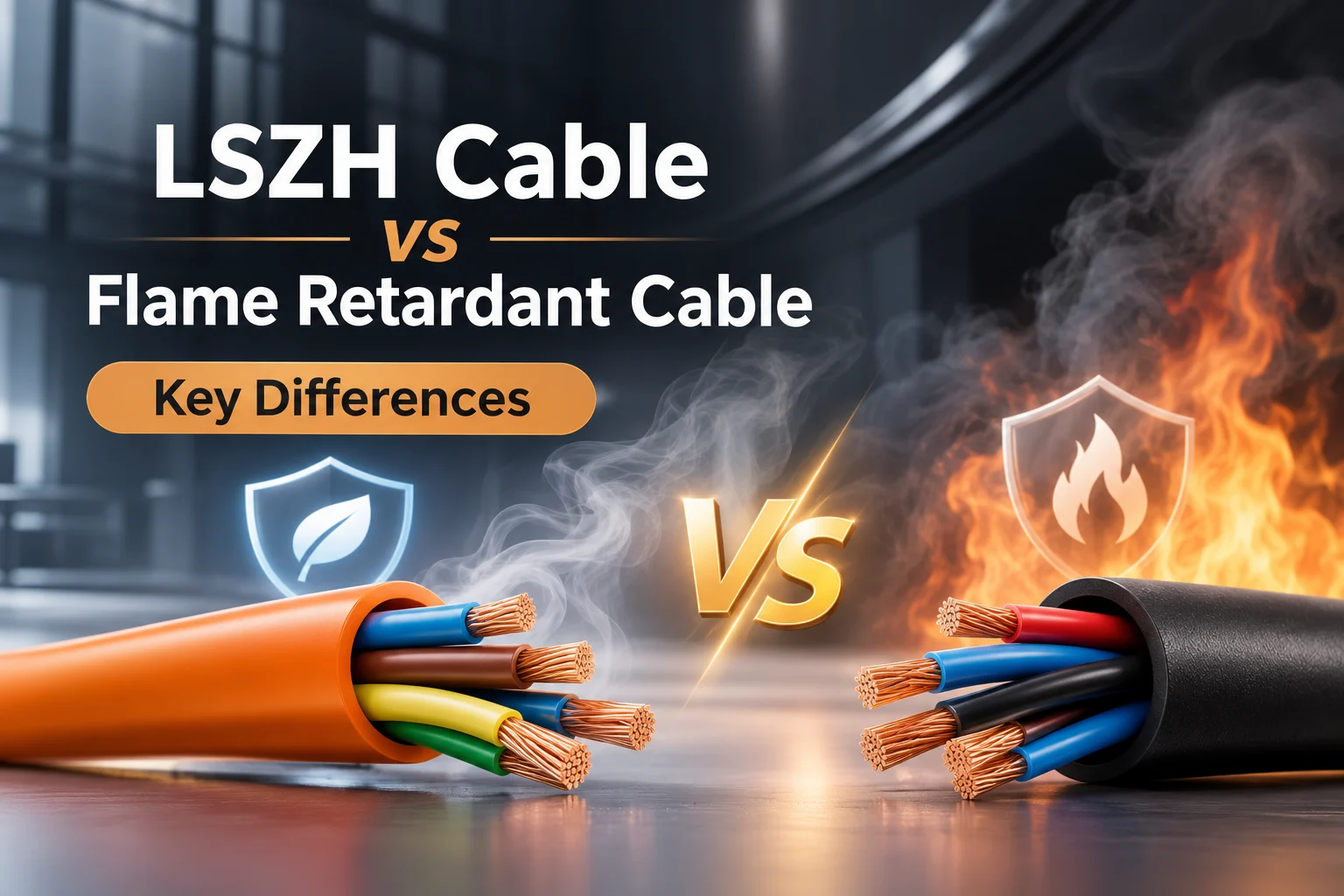
When specifying cables for industrial equipment, data centers, transportation systems, or medical devices, buyers often confuse low smoke zero halogen cable with flame retardant cable. These terms describe different safety characteristics. LSZH cables are designed to limit smoke emission and halogen acid gas release during combustion. Flame retardant cables are designed to reduce flame propagation and help prevent fire from spreading along cable routes. However, a cable can be flame retardant without being halogen-free. Likewise, an LSZH cable does not automatically meet every flame propagation requirement. Understanding these differences helps OEMs and electrical engineers select suitable materials and develop reliable custom cable assemblies.
1. What Does LSZH (Low Smoke Zero Halogen) Mean?
LSZH stands for Low Smoke Zero Halogen. It describes cable insulation or jacket materials designed to produce limited smoke and low levels of halogen acid gas when exposed to fire.
The primary purpose of LSZH cable is to reduce certain hazardous combustion emissions. This is particularly important in enclosed spaces where smoke accumulation, poor visibility, and corrosive gases can create additional risks.
Chemical Composition: Halogen-Free Polyolefin vs. Halogenated Compounds
Traditional PVC cable jackets contain chlorine, which is a halogen. Some other cable materials may also contain halogen-based compounds.
When PVC burns, it can release hydrogen chloride (HCl) gas. This gas is corrosive and can form hydrochloric acid when it contacts moisture. Combustion may also produce dense smoke and other hazardous substances.
LSZH cable compounds typically use halogen-free polymer systems, often based on polyolefins. Mineral fillers such as aluminum hydroxide or magnesium hydroxide may be added to improve fire performance.
These fillers can release water when heated and help absorb heat or dilute combustible gases. The exact formulation depends on the required mechanical, electrical, and fire-performance properties.
However, LSZH does not mean completely non-toxic or smoke-free. Any cable combustion can produce hazardous gases and particles. Actual emissions depend on the polymer formulation, additives, and burning conditions.
For this reason, buyers should evaluate LSZH cable using documented test results rather than relying on the material label alone.
Key Safety Standards for LSZH Cables: IEC 60754 and IEC 61034
Two important IEC standards help evaluate the smoke and gas characteristics of cable materials.
IEC 60754: Halogen Acid Gas Assessment
IEC 60754 includes test methods for determining the amount and characteristics of acid gases released during combustion.
- IEC 60754-1 determines the amount of halogen acid gas generated by cable materials.
- IEC 60754-2 evaluates acidity and conductivity of gases produced during combustion.
These tests help buyers assess whether a cable material meets the specified halogen acid gas requirements.
IEC 61034: Smoke Density Measurement
IEC 61034 evaluates smoke density by measuring light transmittance inside a test chamber during cable combustion.
Higher light transmittance generally indicates lower smoke density under the test conditions.
This matters in enclosed environments. Dense smoke can reduce visibility and make evacuation more difficult.
When specifying an LSZH cable assembly, buyers should check the actual test method, acceptance criteria, and tested cable construction. A general LSZH description is not a substitute for a documented compliance requirement.
2. What Does Flame Retardant Mean?
A flame retardant cable is designed to limit flame propagation under specified test conditions.
Its purpose is to reduce the likelihood that a fire will spread along individual cables or groups of cables. Depending on the cable design and applicable test standard, the material may also help the cable stop burning after the ignition source is removed.
Flame retardancy is especially important in cable trays, electrical cabinets, industrial control systems, and building communication networks.
How Flame Retardant Jackets Slow Fire Propagation and Self-Extinguish
Flame retardant cable compounds use different mechanisms to reduce combustion.
Common approaches include:
- Endothermic decomposition: Aluminum hydroxide and magnesium hydroxide can absorb heat and release water vapor when heated.
- Heat and oxygen barrier formation: Some additives promote the formation of a protective char or mineral residue.
- Gas-phase flame inhibition: Certain flame retardant systems interfere with the chemical reactions that sustain combustion.
- Reduced combustible material contribution: Proper compound design can help limit the amount of fuel available to support flame propagation.
The final performance depends on the polymer base, additive concentration, jacket thickness, cable structure, and manufacturing process.
A flame retardant cable is not necessarily fireproof. It can still burn under sufficient heat exposure. Its performance should always be evaluated against the relevant test standard and installation conditions.
Flame Retardancy Does Not Automatically Mean Halogen-Free
This is one of the most important distinctions in cable selection.
A PVC cable can achieve flame retardant performance through its material properties and suitable additive systems. However, PVC contains chlorine and can release hydrogen chloride during combustion.
Therefore, a cable can meet a specified flame propagation test while still producing halogen acid gases.
Similarly, an LSZH cable may have low smoke and halogen acid gas emissions but still require additional testing to confirm its flame propagation performance.
The two characteristics should be treated as separate specifications:
- LSZH: Focuses on smoke emission and halogen acid gas release.
- Flame retardant: Focuses on limiting flame propagation under defined test conditions.
- LSZH flame retardant cable: Combines low-smoke, halogen-free material requirements with specified flame performance.
For demanding projects, buyers should specify both requirements when both are necessary.
3. LSZH vs. PVC Cable Materials: Performance Comparison
LSZH and PVC are common cable jacket material options. Their differences involve more than fire performance. Mechanical flexibility, chemical resistance, processing requirements, and total project cost also influence material selection.
LSZH vs PVC Cable: Key Performance Differences
| Comparison Factor | LSZH Cable | PVC Cable |
|---|---|---|
| Smoke Emission | Designed for reduced smoke under specified test conditions | Can produce dense smoke during combustion |
| Halogen Acid Gas | Designed to meet defined halogen acid gas limits | Contains chlorine and can release HCl during combustion |
| Flame Spread | Depends on the specific compound and cable test results | Can achieve flame retardant performance with suitable formulation |
| Flexibility | Depends on polymer formulation; some compounds may feel stiffer | Often offers good flexibility across different grades |
| Bend Radius | Must follow the cable manufacturer’s specifications | Must follow the cable manufacturer’s specifications |
| Abrasion Resistance | Varies by formulation and jacket construction | Often offers good abrasion resistance, depending on grade |
| Chemical and Oil Resistance | Depends on the selected LSZH compound | Depends on PVC grade and exposure conditions |
| Material Cost | Often higher than comparable standard PVC compounds | Often more economical for general-purpose applications |
| Typical Applications | Rail transit, tunnels, data centers, public buildings, and enclosed equipment | General industrial wiring, equipment wiring, and applications where PVC is permitted |
Note: These are general material comparisons. Actual performance varies by compound grade, cable construction, and test conditions. Buyers should review the manufacturer’s technical data and test reports.
Mechanical Flexibility, Abrasion Resistance, and Cost Trade-Offs
Early or basic LSZH formulations were sometimes less flexible than conventional PVC compounds. This could create challenges in applications involving repeated bending, tight installation spaces, or complex cable routing.
Modern LSZH compounds have improved through polymer modification, additive optimization, and different material processing technologies.
However, not every LSZH cable has the same mechanical properties. Some formulations prioritize low smoke and halogen-free performance, while others are designed to improve flexibility, abrasion resistance, or low-temperature performance.
Before selecting an LSZH cable assembly, consider the following factors:
1. Minimum Bend Radius
Check the manufacturer’s specified minimum bend radius. A cable that is too stiff for the installation layout may experience excessive mechanical stress.
2. Repeated Flexing Requirements
For moving equipment, robotic systems, or automated production lines, evaluate the cable’s suitability for dynamic bending or torsional movement. A standard LSZH jacket does not automatically make a cable suitable for continuous flexing.
3. Abrasion and Chemical Exposure
Consider contact with metal edges, oils, cleaning agents, coolants, and other substances. Request material-specific resistance data when the application involves regular exposure.
4. Total Project Cost
LSZH compounds may have a higher material cost than standard PVC. However, material price should be evaluated alongside installation conditions, safety requirements, maintenance considerations, and project compliance requirements.
The most suitable material is the one that meets the actual application requirements without unnecessary over-specification.
4. Flame Retardant Testing and Cable Performance Standards
Cable fire performance cannot be determined by material names alone. Engineers should identify the relevant test standard, cable configuration, and required acceptance criteria before approving a design.
Vertical Single-Cable Tests vs. Bunched Cable Tests
Two important IEC test series evaluate flame propagation under different installation conditions.
IEC 60332-1-2: Single-Cable Flame Propagation Test
IEC 60332-1-2 evaluates the vertical flame propagation characteristics of a single insulated wire or cable under a defined test procedure using a 1 kW premixed flame.
It is relevant when assessing the fire behavior of an individual cable.
IEC 60332-3: Vertical Flame Spread of Bunched Cables
IEC 60332-3 evaluates flame propagation along vertically installed bundles of cables.
The test uses defined cable quantities, mounting arrangements, and exposure conditions. Different categories represent different test configurations and requirements.
This distinction matters because cables installed individually may behave differently from cables grouped in a dense tray or shaft.
For example, a data center may contain many power, control, and communication cables routed together. In such installations, engineers should assess whether a single-cable test is sufficient or whether a bunched-cable test is also required.
UL VW-1: Vertical Wire Flame Test
UL VW-1 is another commonly referenced vertical flame test for insulated wires and cables. It evaluates the ability of a specimen to resist flame propagation under defined test conditions.
UL VW-1 and IEC 60332-1-2 are different test methods. Their results should not be treated as automatically interchangeable.
When preparing a cable specification, identify the exact standard and test level required by the equipment or project.
UL Flammability Ratings: UL 94 V-0, CM, CMR, and CMP
Buyers may encounter UL 94 and communication cable classifications when sourcing custom wire harnesses.
However, these classifications apply to different product types and test purposes.
UL 94 V-0
UL 94 is a plastics flammability standard. V-0 is a vertical burning classification for plastic materials under defined specimen and test conditions.
It is commonly used when evaluating plastic components, insulation materials, and other polymer parts.
A V-0 rating for a plastic material does not automatically establish that a finished cable assembly meets a cable flame propagation standard.
CM, CMR, and CMP
These classifications are associated with communications cables and their permitted installation applications under relevant North American requirements.
- CM: General-purpose communications cable classification.
- CMR: Riser-rated communications cable intended for specified vertical building pathways.
- CMP: Plenum-rated communications cable intended for specified environmental-air spaces.
These classifications are not generic ratings for every custom wire harness. Their applicability depends on cable construction, listing, installation location, and relevant code requirements.
For OEM cable assembly projects, engineers should confirm whether the requirement applies to the cable itself, the complete assembly, or another component.
5. How to Select Cables for Industrial and Commercial Equipment
Selecting the right cable requires more than comparing LSZH and PVC material prices. Buyers should consider the installation environment, fire risk, mechanical conditions, electrical requirements, and target-market regulations.
When Are LSZH Flame-Retardant Cables Required?
LSZH and flame-retardant requirements are particularly relevant in environments where smoke, corrosive combustion gases, or fire propagation could create additional risks.
Rail Transit and Underground Infrastructure
Subways, tunnels, railway stations, and train systems often contain enclosed cable routes and areas with limited ventilation.
Project specifications may require low-smoke, halogen-free materials and defined flame propagation performance.
Data Centers and Communication Rooms
Data centers contain large quantities of power and communication cables. Smoke and corrosive gases can affect equipment and complicate emergency response.
Cable selection should consider smoke performance, halogen acid gas limits, flame propagation, and the applicable installation code.
Medical Equipment and Healthcare Facilities
Hospitals and medical equipment environments may require carefully controlled cable materials and documented product compliance.
For medical devices, cable selection should also consider electrical insulation, flexibility, cleaning exposure, biocompatibility where relevant, and the device’s applicable regulatory requirements. LSZH alone does not establish medical-device compliance.
Public Buildings and Commercial Facilities
Airports, shopping centers, office buildings, and other public facilities may have project-specific requirements for low-smoke or flame-retardant cables.
The applicable requirements depend on local building codes, installation locations, and project specifications.
Marine and Industrial Applications
Ships, offshore facilities, and industrial plants may require cable materials that meet specific smoke, halogen, flame, oil, or environmental performance requirements.
Do not assume that one LSZH or flame-retardant formulation is suitable for every marine or industrial application.
Specifying Custom LSZH or Flame-Retardant Cable Assemblies with Your Manufacturer
For OEM and ODM projects, material selection should be integrated into the complete cable assembly design.
A suitable specification helps the manufacturer select compatible wire, insulation, connectors, protective sleeves, and other components.
Before requesting a quotation, prepare the following information:
| Specification Item | Information to Provide | Why It Matters |
|---|---|---|
| Application | Equipment type and installation environment | Defines operating and safety requirements |
| Cable Construction | Single-core, multicore, shielded, or unshielded | Determines electrical and mechanical design |
| Jacket Material | LSZH, PVC, or another specified compound | Establishes material requirements |
| Fire Performance | Required IEC or UL test standard and level | Defines the required flame performance |
| Smoke and Halogen Limits | Applicable IEC 60754 and IEC 61034 requirements | Confirms emission-related requirements |
| Electrical Parameters | Voltage, current, conductor size, and insulation requirements | Supports electrical safety and performance |
| Mechanical Requirements | Bend radius, flex cycles, abrasion, and routing conditions | Helps ensure installation suitability |
| Connector Requirements | Connector model, pinout, and termination method | Ensures interface compatibility |
| Compliance Documents | Required test reports and market-specific documentation | Supports project approval and traceability |
For example, a buyer developing a cable harness for an enclosed control cabinet may need LSZH materials, a defined flame propagation rating, shielding, and specific connector interfaces.
A railway project may require additional bunched-cable flame testing and other application-specific approvals.
The requirements should be confirmed before production rather than inferred from a general material description.
Understanding Target-Market Compliance
Different markets and industries may require different standards and documentation.
- UL: Relevant UL standards and product listings may apply to specific wires, cables, and components.
- CE: CE marking is relevant to applicable EU legislation. It is not a general cable fire-performance certification.
- RoHS: Addresses restrictions on certain hazardous substances in electrical and electronic equipment.
- REACH: Addresses chemical substances and related obligations in the EU market.
RoHS and REACH compliance do not independently prove that a cable is LSZH or flame retardant. Similarly, CE marking does not replace the need to verify the applicable cable fire tests.
For custom cable assemblies, buyers should confirm which documents apply to the complete product and which apply only to individual materials or components.
6. Conclusion: How to Choose Between LSZH and Flame Retardant Cable
The key difference between LSZH and flame retardant cable is the safety characteristic each term describes.
Low smoke zero halogen cable focuses on reducing smoke emission and halogen acid gas release during combustion. Flame retardant cable focuses on limiting flame propagation under defined test conditions.
Neither term automatically guarantees the other performance characteristic. An LSZH cable may still need additional flame testing, while a flame retardant PVC cable may still release halogen acid gases when burned.
For OEM and ODM cable assembly projects, the best selection process starts with the installation environment and applicable safety requirements. Buyers should specify the required material, flame test standard, smoke and halogen limits, electrical parameters, and mechanical conditions.
A well-defined specification helps manufacturers select suitable cable materials and connector components while reducing the risk of compliance problems during project validation.
Need Custom LSZH or Flame-Retardant Cable Assemblies?
HINI-Cable supports OEM and ODM cable assembly projects based on customer drawings, electrical specifications, and application requirements. Share your harness drawings, target market, and required safety standards with our engineering team to discuss a suitable cable assembly solution.
Where specified by the project, testing can include continuity, insulation resistance, and dielectric withstand (Hi-Pot) checks to help verify electrical performance.