+8613662928075
 sales@hinicable.com


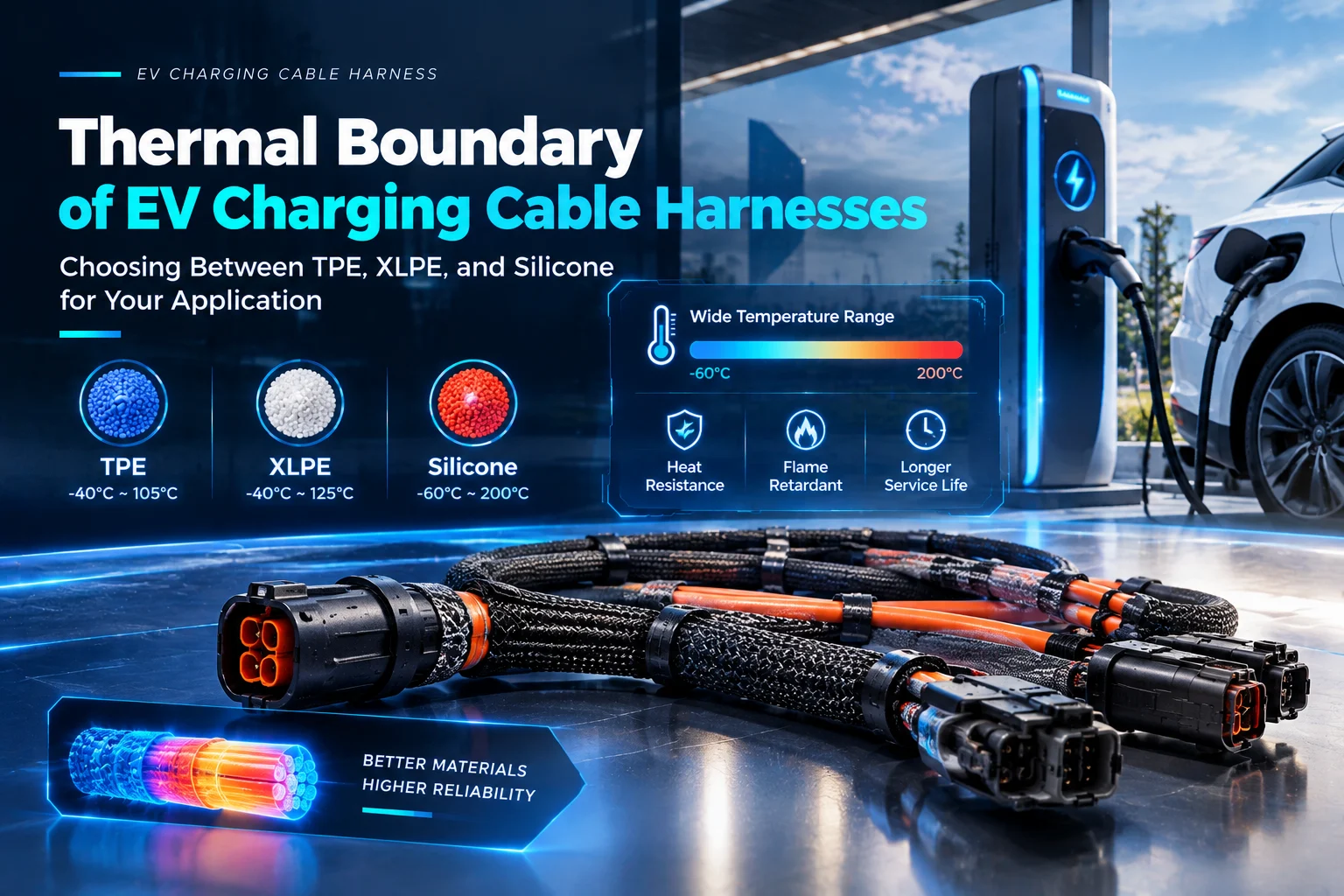
TPE vs. XLPE vs. Silicone: How to Choose Cable Insulation for EV Charging and Energy Storage
Choosing the right cable insulation material is critical for EV charging cable harnesses, battery energy storage systems (BESS), and industrial electrical wiring. The wrong insulation can lead to thermal degradation, reduced flexibility, premature cable failure, and higher maintenance costs.
For B2B buyers, including renewable energy equipment manufacturers, automotive component procurement teams, and industrial electrical distributors, three materials deserve particular attention: thermoplastic elastomer (TPE), cross-linked polyethylene (XLPE/XLPO), and silicone rubber.
Each material offers different advantages in temperature resistance, flexibility, mechanical durability, and environmental protection. TPE is commonly selected for flexible outdoor charging cables, XLPE is well suited to many high-temperature internal wiring applications, and silicone rubber performs well in extreme heat environments.
The best cable insulation material depends on the cable’s operating temperature, mechanical movement, environmental exposure, and applicable product standards—not temperature rating alone.
1. TPE vs. XLPE vs. Silicone: Cable Insulation Comparison
Understanding the differences between TPE, XLPE, and silicone rubber helps procurement teams identify suitable materials for specific cable harness applications.
| Comparison Factor | TPE / TPE-S | XLPE / XLPO | Silicone Rubber |
|---|---|---|---|
| Typical temperature capability | Formulation-dependent; some grades support approximately -60°C to 125°C | Formulation-dependent; commonly rated around -40°C to 125°C or 150°C | Common grades may support approximately -60°C to 180°C or 200°C |
| Flexibility | High flexibility and good low-temperature elasticity | Generally stiffer than elastomers | Excellent flexibility and softness |
| Thermal aging | Good with suitable heat-stabilized formulations | Excellent thermal aging performance when properly formulated and cross-linked | Excellent high-temperature stability |
| UV and weather resistance | Good with appropriate weather-resistant grades | Depends on formulation and protective layers | Excellent ozone and weathering resistance |
| Oil and chemical resistance | Depends on polymer type and compound formulation | Often good, depending on the compound and chemical exposure | Varies by formulation and chemical |
| Abrasion and tear resistance | Can offer good abrasion resistance | Generally suitable for fixed wiring applications | Lower tear resistance in some grades |
| Typical applications | Flexible EV charging cables, portable power cords, moving cable assemblies | BESS internal wiring, power distribution, fixed electrical connections | High-temperature equipment wiring and selected internal connections |
Note: These values are indicative ranges, not universal specifications. Actual operating limits depend on the insulation compound, cable construction, conductor temperature, applicable standards, and manufacturer test data.
1.1 TPE Insulation: Flexibility for Outdoor EV Charging Cables
Thermoplastic elastomer (TPE) combines rubber-like flexibility with thermoplastic processing characteristics. It is a practical option for cable assemblies that require frequent handling, bending, and coiling.
Key advantages include:
- Cold-weather flexibility: Suitable formulations can maintain elasticity in sub-zero environments.
- Handling comfort: Flexible jackets make charging cables easier to coil, transport, and store.
- Weather resistance: Outdoor-grade compounds can provide resistance to UV exposure, moisture, and environmental aging.
- Manufacturing versatility: Different grades can be selected to balance flexibility, abrasion resistance, and processing requirements.
For EV charging cable harnesses, TPE is particularly relevant to portable charging cords, public charging cables, and applications involving repeated handling.
However, not every TPE formulation provides the same performance. Buyers should verify low-temperature bending behavior, abrasion resistance, UV aging results, and the required flame-retardant properties before approving a material.
1.2 XLPE and XLPO Insulation: Thermal Stability for Internal Wiring
Cross-linked polyethylene (XLPE) is produced by creating chemical or physical cross-links between polymer chains. This structure improves resistance to heat-induced deformation compared with conventional non-cross-linked polyethylene.
XLPO refers to cross-linked polyolefin compounds, which can include polyethylene-based and other polyolefin formulations.
Their principal advantages include:
- Improved thermal performance: Suitable grades can withstand elevated conductor operating temperatures.
- Resistance to deformation: Cross-linking helps the insulation retain its shape under specified thermal conditions.
- Electrical insulation performance: Properly designed compounds can provide reliable dielectric properties.
- Suitability for fixed routing: These materials are widely used in power cables and internal electrical connections.
For battery energy storage systems, XLPE or XLPO may be suitable for internal power wiring, battery connections, and electrical cabinet assemblies, provided the selected construction meets the project’s electrical and thermal requirements.
One important consideration is flexibility. XLPE is generally less compliant than TPE or silicone rubber, although the finished cable’s bending performance also depends on conductor stranding, insulation thickness, and overall construction.
For installations involving continuous movement or tight bending radii, procurement teams should evaluate the complete cable assembly rather than selecting XLPE based on temperature resistance alone.
1.3 Silicone Rubber Insulation: Performance in Extreme Heat
Silicone rubber is known for maintaining flexibility across a broad temperature range. It is particularly useful where conventional cable insulation materials may become unsuitable because of elevated operating temperatures.
Its key advantages include:
- High-temperature capability: Some grades support continuous operating temperatures around 180°C to 200°C.
- Low-temperature flexibility: Suitable compounds remain pliable in very cold conditions.
- Ozone and weather resistance: Silicone performs well in many demanding outdoor and industrial environments.
- Long-term flexibility: It can be appropriate for equipment exposed to repeated thermal cycling.
Silicone rubber is commonly considered for high-temperature equipment wiring, selected battery module connections, and industrial applications where thermal performance is a primary requirement.
However, silicone is not automatically the best choice for every flexible cable. Some grades have lower tear and abrasion resistance than purpose-designed TPE compounds. In applications involving dragging, vehicle traffic, or repeated connector handling, additional mechanical protection may be necessary.
2. Three Environmental Factors That Determine Cable Insulation Selection
Material selection should begin with the actual operating environment. For EV charging cable harnesses and energy storage wiring, three factors are especially important: outdoor exposure, thermal buildup, and repeated mechanical stress.
2.1 Outdoor EV Charging: UV Exposure and Low-Temperature Flexibility
Public EV charging cables may experience direct sunlight, rain, temperature fluctuations, and frequent coiling. In cold regions, cable flexibility can become a significant usability and reliability concern.
Conventional PVC formulations may become stiffer at low temperatures, while prolonged UV exposure can accelerate aging in unsuitable compounds.
Weather-resistant TPE formulations can offer a useful balance of cold-weather flexibility, abrasion resistance, and outdoor durability. Some grades are designed for demanding sub-zero conditions, including applications requiring performance at -40°C.
When sourcing outdoor EV charging cable harnesses, buyers should evaluate:
- Low-temperature bending and impact performance.
- UV and weathering resistance.
- Abrasion, tear, and cut resistance.
- Water exposure and relevant ingress-protection requirements for the complete assembly.
- Flame-retardant performance and applicable charging-cable standards.
Procurement recommendation: Prioritize TPE when cable handling and flexibility are essential, but confirm the exact compound and finished-cable certification requirements before placing bulk orders.
2.2 Battery Energy Storage Systems: Heat Buildup and Thermal Aging
Battery energy storage systems can experience substantial temperature variation during charging, discharging, and high-load operation. Heat may accumulate inside cabinets because of component density, restricted airflow, ambient conditions, or cooling-system limitations.
The temperature around a cable is not necessarily the same as the conductor temperature. Electrical current, conductor resistance, cable bundling, installation conditions, and cooling performance all influence the final operating temperature.
XLPE and suitable XLPO compounds can provide improved thermal stability for many internal wiring applications. Silicone rubber may be preferable where local hot spots or higher temperature requirements exceed the capabilities of other candidate materials.
Before specifying insulation, buyers should confirm:
- Maximum ambient and conductor temperatures.
- Continuous and short-term overload conditions.
- Voltage rating and required dielectric performance.
- Compatibility with battery electrolytes, coolants, oils, or other chemicals where exposure is possible.
- Thermal aging performance and the required service life.
Procurement recommendation: Select XLPE or XLPO for suitable fixed internal wiring applications, and consider silicone where the verified thermal requirements justify its use. Do not assume that all BESS cabinets operate above 85°C; assess the actual design and measured operating conditions.
2.3 Repeated Bending, Abrasion, and Connector Stress
EV charging cables are repeatedly coiled, uncoiled, handled, and connected. Industrial cable harnesses may also experience vibration, movement, and mechanical stress around connectors.
These conditions can damage insulation even when operating temperatures remain within the rated limits.
TPE can provide a useful combination of flexibility and abrasion resistance. Silicone offers excellent flexibility but may require additional protection where cutting, tearing, or surface abrasion is a concern. XLPE is often appropriate for fixed routing, but a conventional XLPE construction may not be suitable for applications requiring continuous flexing.
For demanding installations, evaluate the complete cable structure, including:
- Conductor stranding and flexibility.
- Insulation and outer-jacket material.
- Minimum bending radius.
- Connector strain relief.
- Abrasion and mechanical endurance test results.
- Resistance to repeated flexing and environmental aging.
Procurement recommendation: For moving or frequently handled cables, assess the complete assembly’s mechanical endurance. A high temperature rating alone does not establish suitability for dynamic applications.
3. How to Select Cable Insulation for Different Applications
The following matrix provides a practical starting point for B2B sourcing decisions.
| Application | Initial Material Candidate | Main Selection Priority | Key Verification |
|---|---|---|---|
| Public EV charging cable | Outdoor-grade TPE or another certified flexible compound | Flexibility, abrasion, weather resistance | Applicable charging-cable standard and low-temperature tests |
| Portable EV charging cord | Flexible TPE or a qualified alternative | Coiling ease, handling, cold-weather performance | Flex testing, jacket durability, electrical rating |
| BESS internal power wiring | XLPE or suitable XLPO | Thermal stability, dielectric performance | Voltage rating, conductor temperature, thermal aging |
| High-temperature equipment wiring | Silicone rubber or another temperature-rated compound | Continuous heat resistance | Temperature classification, electrical and mechanical tests |
| Frequently moving industrial cable | Application-specific flexible compound | Bending endurance, tear resistance, service life | Dynamic flex testing and minimum bending radius |
This matrix is a preliminary selection guide, not a substitute for engineering validation. Final material approval should account for the cable design, electrical loading, installation environment, applicable regulations, and manufacturer test reports.
4. Cable Insulation Standards: UL 2263 vs. EN 50620
For international EV charging cable procurement, compliance requirements should be confirmed early in the product development process.
UL 2263 and EN 50620 are relevant references in certain North American and European EV charging applications, respectively. However, their scope and applicability depend on the specific cable or equipment configuration. They should not be treated as interchangeable material specifications.
UL 2263: Verify the Applicable North American Requirements
UL 2263 addresses electric vehicle supply cords and related requirements within its defined scope. Buyers should verify the current edition, product category, and applicable certification conditions for their intended application.
Relevant evaluation areas may include electrical performance, temperature exposure, mechanical durability, and other tests specified by the applicable certification requirements.
Do not assume that every cable must meet the same flame test or that a particular insulation compound is automatically compliant. Confirm the exact requirements with the certification documentation and qualified testing provider.
EN 50620: Verify European EV Charging Cable Requirements
EN 50620 specifies requirements for electric vehicle charging cables within its scope. It addresses cable construction and performance requirements relevant to EV charging applications.
Depending on the applicable edition and cable type, buyers may need to review electrical ratings, mechanical properties, temperature performance, and other prescribed tests.
Halogen-free and low-smoke performance should be verified against the relevant material classifications and project requirements rather than assumed solely from the standard’s name.
What Procurement Teams Should Request from Suppliers
Before approving a cable harness supplier, request documentation covering:
- Applicable product standards and certification scope.
- Insulation and jacket material specifications.
- Rated voltage and continuous conductor temperature.
- Low-temperature flexibility and mechanical endurance results, where required.
- UV, chemical, and thermal aging data for the intended environment.
- Traceable test reports and material change-control procedures.
Important: A cable made with TPE, XLPE, XLPO, or silicone rubber is not automatically compliant with UL 2263, EN 50620, or another regional standard. Compliance applies to the relevant product construction and verified testing or certification process.
5. Frequently Asked Questions About Cable Insulation Materials
Q1. Is TPE or XLPE better for EV charging cable harnesses?
TPE is often a strong candidate for flexible outdoor EV charging cables because of its elasticity, handling comfort, and availability of weather-resistant formulations.
XLPE is generally more suitable for many fixed internal wiring applications requiring elevated thermal performance. The final choice depends on the charging cable design, applicable standard, electrical rating, and environmental requirements.
Q2. Which cable insulation material is best for high-temperature environments?
Silicone rubber is often considered for applications requiring continuous operating temperatures around 180°C or higher, provided the selected grade is rated for the intended conditions.
XLPE and XLPO can also support elevated temperatures, commonly around 125°C or 150°C for certain constructions. Always verify the manufacturer’s rated temperature and the applicable cable standard.
Q3. Does a 125°C insulation rating guarantee long-term reliability?
No. A temperature rating does not independently establish service life or environmental durability.
Long-term reliability also depends on thermal aging, electrical stress, UV exposure, chemical compatibility, mechanical loading, and installation conditions. Request supporting test data for the intended operating environment.
Q4. Is silicone rubber suitable for outdoor EV charging cables?
Silicone can provide excellent thermal stability and ozone resistance, but its mechanical performance varies by grade. Some formulations are more vulnerable to tearing or abrasion than purpose-designed cable jacket compounds.
For frequently handled charging cables, compare silicone with outdoor-grade TPE and other certified flexible materials using complete-cable test results.
Q5. What information should buyers provide when requesting a custom cable harness quotation?
To improve quotation accuracy, provide the following details:
- Application: EV charging, BESS wiring, or industrial electrical equipment.
- Rated voltage and expected current.
- Operating temperature range and duty cycle.
- Required conductor size, strand construction, and cable length.
- Insulation and jacket preferences, if already defined.
- Environmental exposure, including UV, oil, chemicals, moisture, and abrasion.
- Applicable standards, certifications, target market, and estimated order quantity.
These details help suppliers recommend an appropriate cable construction, identify testing requirements, and evaluate customization options.
Conclusion: Match Cable Insulation to the Actual Operating Environment
Choosing between TPE, XLPE, XLPO, and silicone rubber requires balancing thermal performance, flexibility, mechanical durability, and regulatory compliance.
- Choose TPE as an initial candidate for flexible EV charging cables requiring good handling characteristics and outdoor durability.
- Consider XLPE or XLPO for suitable fixed internal wiring applications where thermal stability and electrical performance are priorities.
- Evaluate silicone rubber for high-temperature applications where its operating-temperature capability justifies the additional material and mechanical-design considerations.
For B2B buyers, the most reliable sourcing decision combines material data sheets, complete-cable performance tests, applicable certifications, and actual operating conditions.
Need a Custom Cable Harness Solution?
Whether your project involves EV charging infrastructure, battery energy storage systems, or industrial electrical equipment, selecting the right insulation is only one part of reliable cable harness design.
Work with an experienced cable harness manufacturer to review operating conditions, conductor specifications, insulation options, certification requirements, and production needs. Validated materials and cable construction can help reduce premature failures, improve service reliability, and support long-term procurement goals.