+8613662928075
 sales@hinicable.com


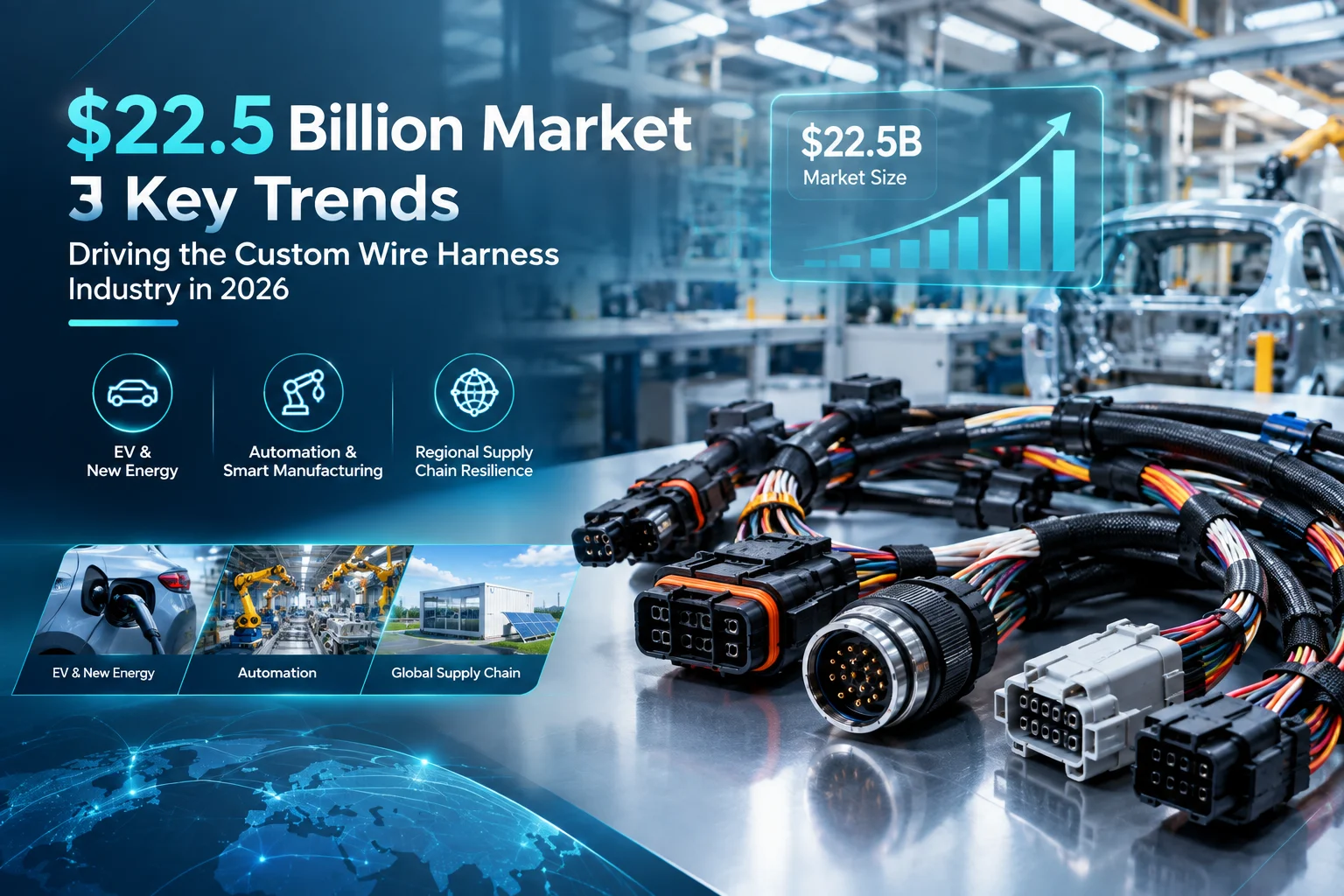
According to market research data from GNY Research, the global custom wire harness market is projected to achieve sales revenues of $22.5 billion in 2026. Expanding at a compound annual growth rate (CAGR) of approximately 3.6%, the market is expected to reach $278 billion by 2032.
Behind these macroeconomic figures lies a fundamental shift in how OEMs, system integrators, and industrial procurement managers approach power and signal interconnects. Standard off-the-shelf cables are increasingly giving way to specialized, application-specific harness designs.
Understanding the structural trends driving this market evolution enables procurement executives to make informed supplier selection decisions, mitigate supply chain risks, and optimize product performance.
            GLOBAL CUSTOM WIRE HARNESS MARKET GROWTH

  2026: $22.5 Billion ──► CAGR ~3.6% ──► 2032: $27.8 Billion

  KEY MARKET DRIVERS:
  1. APAC Regional Manufacturing Dominance
  2. Acceleration of Hybrid Harnesses (Power + Signal + Data)
  3. High-Growth Industrial Automation & Smart Manufacturing
Trend 1: APAC Continues to Dominate Global Production and Consumption
The Asia-Pacific (APAC) region continues to lead both global manufacturing capacity and end-market consumption for the custom wire harness sector.
Why Regional Concentration Matters for Procurement
Countries across APAC—particularly China, Japan, South Korea, and Southeast Asian manufacturing hubs—host the world’s most concentrated supply chains for raw copper, specialized polymers, terminal connectors, and automated processing equipment.
-
Localized Supply Chain Integration: Sourcing directly from suppliers deeply rooted in the APAC ecosystem drastically reduces component lead times, raw material shipping costs, and bill-of-materials (BOM) overhead.
-
Agile Tooling & Engineering Turnaround: APAC-based custom harness manufacturers offer rapid prototyping, custom die creation, and flexible production scheduling compared to traditional Western markets.
Trend 2: Surge in Demand for Hybrid Wire Harnesses (Power + Signal + Data Integration)
As industrial machinery, medical devices, and robotic systems become more compact and digitally interconnected, separate wiring runs for power, control signals, and high-speed data are no longer practical. The market is rapidly shifting toward hybrid wire harness assembly designs.
| Architecture | Cable Configuration | Main Components | Assembly Structure |
|---|---|---|---|
| Traditional Approach | 3 separate cables | Power Cable + Signal Wire + Ethernet / Data Cable | Multiple independent cables |
| Modern Hybrid Approach | 1 integrated assembly | Heavy Power Conductor + Shielded Twisted Pair + Fiber Optic / Data Line | Multiple conductors integrated under a common outer sheath |
Strategic Implications for Supplier Selection
A hybrid custom wire harness combines high-voltage/high-current conductors alongside sensitive, low-voltage communication lines (such as Industrial Ethernet, CAN bus, or fiber optics) inside a single protective jacket.
-
Engineering Capability Threshold: Integrating power and data requires sophisticated electromagnetic interference (EMI) shielding, precise twisting lay-lengths, and cross-talk prevention.
-
Supplier Requirements: Procurement teams must select a custom wire harness manufacturer capable of co-extruding complex cables, validating signal integrity, and executing precision multi-conductor terminal crimping under one roof.
Trend 3: Industrial Equipment Harnesses Become the Fastest-Growing Segment
Driven by global investments in Industry 4.0, advanced robotics, smart factories, and energy storage systems (ESS), industrial equipment harnesses are outpacing traditional commercial cable segments.
| Industry Sector | Primary Application | Key Performance Requirement | Custom Harness Value Driver |
| Robotics & Motion Control | Multi-axis robot arms, gantry systems | High torsional flexing lifecycle ($>10\text{ million}$ cycles) | Custom continuous-flex jackets & strain relief elements |
| Smart Manufacturing & AGVs | Automated Guided Vehicles, conveyor drives | Compact routing, vibration resistance, IP67 seals | Custom overmolded connectors & integrated junction blocks |
| Energy & Power Storage | ESS battery racks, inverter stations | High voltage, flame retardancy (UL94 V-0) | Heavy-gauge custom bussing, thermal-resistant sleeving |
Customization vs. Standard Off-the-Shelf: Strategic B2B Value
Choosing a tailored custom wire harness over standardized catalog cables provides measurable financial and operational advantages across a product’s lifecycle:
1. Reduced Assembly Labor & Error Elimination
Custom harnesses arrive with exact branch lengths, pre-labeled wires, color-coded connector housings, and integrated mounting breakouts. This “plug-and-play” delivery eliminates manual cutting, stripping, and routing errors on the assembly floor, cutting system integration time significantly.
2. Enhanced Mechanical Durability & EMI Shielding
Standard cables often fail prematurely when exposed to dynamic bending, oil, abrasion, or harsh ambient temperatures. Custom harness engineering allows buyers to specify application-exact jacketing materials (e.g., PUR, TPU, Teflon) and custom braided shielding to prevent electrical noise in harsh environments.
3. Supply Chain Consolidation
Purchasing individual wires, terminals, heat-shrink tubing, and connectors creates a complex supply chain with dozens of line items. Working with a dedicated custom wire harness manufacturer consolidates complex assembly subsystems into a single SKU, streamlining inventory management and procurement logistics.
Summary & Custom Harness Engineering Solutions by HINI-Cable
As the global custom wire harness market expands toward $27.8 billion by 2032, navigating market trends requires choosing flexible, high-capability manufacturing partners. Capitalizing on APAC production capabilities, specifying hybrid power-and-data cable integration, and deploying ruggedized industrial harnesses directly translates into lower assembly costs, higher product reliability, and faster time-to-market.
Partner with HINI-Cable for Advanced Custom Harness Manufacturing
At HINI-Cable, we specialize in the design, engineering, prototyping, and full-scale production of high-reliability industrial custom wire harness solutions for equipment builders, automation specialists, and global OEMs.
-
Advanced Hybrid Integration: Full engineering capabilities to combine heavy power lines, high-speed data pairs, and control signal wiring into compact, EMI-shielded harness configurations.
-
Precision Manufacturing & Quality Audits: Fully automated wire processing, 100% Crimp Force Monitoring (CFM), micro-section testing, and automated optical inspection (AOI) to guarantee zero-defect production.
-
End-to-End B2B Support: From initial DFM (Design for Manufacturability) advice and component cross-referencing to rapid prototyping and scalable mass production.
Position your equipment for future market demands. Contact the engineering team at HINI-Cable today to discuss your project requirements, request technical consultations, or obtain custom manufacturing quotes!